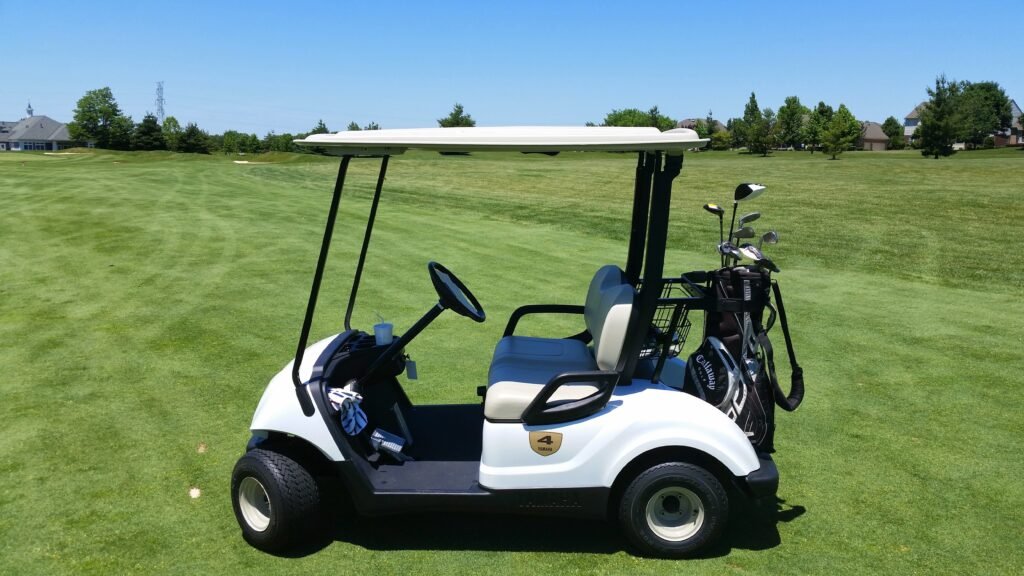
Short answer: The carts we sell publish ranges of roughly 25 to 45 miles per charge, with lithium at the top of that spread and lead-acid at the bottom. Treat any published figure as a best case: load, hills, cold weather, soft ground, low tire pressure and stop-start driving all take miles off it. Size the cart to your longest ordinary day, with room to spare.
What does a golf cart range figure actually mean?
A published range figure is the manufacturer measuring a specific cart, in a specific
configuration, under conditions favorable to a good number. It is not dishonest. It is just a
best case, and you will not be driving in a best case.
How far does a golf cart go on a charge, in published figures?
Among the carts we sell that publish a range, the spread is roughly 25 to 45 miles. Advanced EV quotes 25 to 35 miles for the Advent on six Trojan T875 lead-acid batteries. Kandi quotes 28 miles for the Kruiser Element on a 100Ah lithium pack and 40 for the 4Pro on 150Ah. Denago quotes 40 miles for the Rover XL and 35 to 40 for the six-seat Rover XXL. ICON quotes 40-plus for the i20, i40 and i60 on a 51V/105Ah pack, and Yamaha up to 45 miles for the electric Drive2. Lithium sits at the top of that spread, lead-acid at the bottom, and every figure is the maker’s, measured the maker’s way.
What takes miles off a golf cart’s range?
Load is the big one. A cart carrying four adults and equipment is doing considerably more work
than the one that produced the brochure number. Hills compound it. Cold weather reduces the energy
a battery will usefully give you. Soft ground and low tire pressure add rolling resistance the
whole way. Stop-start driving costs more than steady running.
Why does a lead-acid golf cart lose range as it discharges?
This is the part that surprises people. A lead-acid pack does not deliver its last third the way
it delivered its first. Voltage sags under load, the cart feels slower, and the usable range is
shorter than the raw capacity suggests. Lithium holds voltage far more consistently, which is why a
lithium cart often feels like it has more range than the numbers imply.
How much range do you actually need?
Not the average day, and not the once-a-year trip. If your regular longest run is 18 miles, a
cart rated at 20 is a cart you will occasionally have to nurse home. Leave real margin, because the
margin is what absorbs the cold morning, the extra passenger and the hill you forgot about.
What should you ask instead of “what is the range”?
Instead of asking what the range is, ask what configuration produced that figure: battery
chemistry, capacity, and how many passengers. A range number without a capacity beside it is not
something you can plan around.
How does Terrain report range?
We publish the manufacturer figure and say so. Where a range has not been supplied for a model,
the specification row reads “Not specified” rather than carrying an estimate. A wrong
number that looks confident is worse than an honest blank.