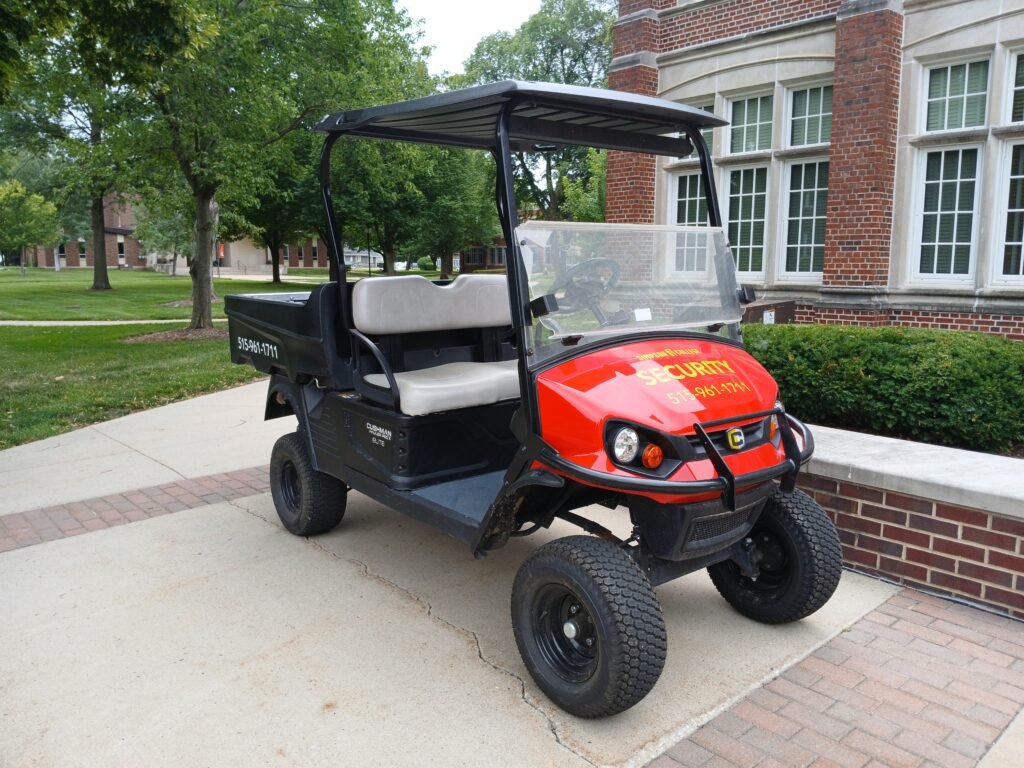
Short answer: Golf cart maintenance starts with the exact battery and vehicle manual. Check tires, steering, brakes, and visible damage before driving. Flooded lead-acid batteries need water-level checks; sealed AGM and lithium packs must not be watered. Gas carts also need engine servicing. Charging and seasonal storage instructions vary by pack, charger, and model.
Where should golf cart maintenance start?
One model can have different batteries, and a pre-owned cart may have a replacement pack. Before choosing a care routine, write down:
- Vehicle model and year
- Battery maker and model
- Chemistry
- Charger model
Use those details to find the correct instructions. A lithium conversion should have its own battery and charger documentation.
Our lithium versus lead-acid guide compares the batteries in our catalog. It does not replace the instructions for the pack installed in your cart.
What should be on a golf cart maintenance checklist?
- Before driving: look for tire damage, leaks, damaged cables, and anything loose. Check that steering and brakes work normally. Stop using a cart that has a new braking or steering problem.
- During routine checks: check tire pressure against the vehicle’s specified setting, inspect the battery area, and clean the cart as its manual directs. Record the date and any problem you find.
- For scheduled service: use the maker’s calendar and operating-hour intervals. Have electrical faults, brake adjustments, and work beyond the owner instructions handled by a qualified technician.
- Before storage: find the battery’s storage charge level, temperature limits, switch position, and checking interval. Do not copy another cart’s settings.
Club Car’s vehicle checklist covers steering, braking, tires, cables, and engine checks. Its gas Onward guidance also specifies oil servicing by operating hours or time. Those intervals apply to that vehicle; they are not a schedule for every brand.
Which golf cart batteries need water?
Flooded lead-acid batteries: inspect the water level on the battery maker’s schedule. Trojan recommends monthly checks initially, then adjusting the interval to actual use. For its flooded batteries, finish normal topping-up after a full charge. If plates are exposed before charging, add only enough water to cover them first. Use distilled water and the fill level specified for the exact battery; do not overfill or add acid. See Trojan’s watering and safety instructions.
Battery electrolyte requires appropriate protective equipment and handling. If you are unsure which batteries you have or how the watering system works, ask a qualified technician before opening anything.
Sealed AGM batteries: no watering. Trojan explicitly prohibits adding water or removing the vents on its AES AGM batteries. Sealed batteries still need suitable charging and inspection of their external connections. See Trojan’s AGM care instructions.
Lithium batteries: no watering. That does not remove the cart’s tire, brake, steering, and connection checks. Club Car’s lithium information distinguishes its enclosed lithium pack from traditional batteries that need watering.
How should I charge and store a golf cart battery?
Use the charger approved for the installed battery. For expected charging duration, see our charge-time table. A published full-charge time is not a reason to interrupt the correct charging cycle or substitute a different charger.
Seasonal storage needs a separate check. For example, E-Z-GO’s August 2024 RXV ELiTE manual distinguishes full charge in cold climates from 30-50% charge in hot climates. It also gives temperature limits and a storage monitoring routine. This example shows why “always store lithium partly charged” is too broad. Use the manual matching your vehicle and pack.
What tire pressure should a golf cart use?
Use the vehicle maker’s setting for the fitted tire and configuration. There is no single pressure we can recommend for every cart in our catalog. Club Car’s electric Onward checklist directs owners to its tire-specific reference. A tire sidewall marking alone should not replace the vehicle’s instructions.
What do the makers’ manuals require, by maker?
The checklist above is general. The figures below are the ones the makers print in their owner’s manuals and maintenance pages for the carts we list, read on October 15, 2026 and linked in the sources at the end. They differ from maker to maker, which is the point: use the row for your cart, not a blend.
| Maker and document | Charging rule | Lead-acid watering | Tire pressure | Long storage |
|---|---|---|---|---|
| E-Z-GO owner’s guides (TXT 48V, Valor 48V, RXV ELiTE lithium, 2019 to 2024 editions) | Charge the batteries after each day’s use; the lithium RXV: charge daily after use | Monthly: check the electrolyte level and add distilled or purified water to 1/2 inch above the plates | 18 to 22 psi (RXV and Valor) | Lead-acid: clean, fully charged, disconnected, recharged at least every 30 days. Lithium: store at full charge in a cold climate and at 30 to 50 percent in a hot one; check the state of charge every 30 days |
| Club Car Onward maintenance pages and fleet storage sheet | No charge-after-use rule stated on the pages we could reach | Every 30 days: check the water level and top up with distilled water only after fully charging | 20 psi or 18 psi depending on the fitted tire (Club Car’s tire chart); the fleet sheet says 18 to 20 psi or as the owner’s manual directs | Lead-acid: keep the car plugged in and check electrolyte and charger monthly; the lithium pack is described as needing no maintenance, with no storage charge level stated |
| Yamaha Drive2 PTV owner’s manuals (PowerTech AC, PowerTech Li, QuieTech EFI; 2026 and 2027 model years) | Charge is a pre-operation item; lithium: charge between 42 and 121 degrees F with the Yamaha lithium charger only | Monthly: check the electrolyte, distilled water only, filled after charging to 1/8 inch below the fill well | 22 psi on the 205/65-10 tire; 20 psi (16 psi on the gas car) on the 18×8.50-8 | Lead-acid: recharge and check fluid at least once a month. Lithium: do not charge before storage, store at 30 to 50 percent state of charge, cycle the pack every six months |
| ICON EV FAQ and spec sheets | Charge daily and let the cycle finish until the indicator turns green, with the ICON charger only | AGM and lithium packs are never watered; older flooded packs take distilled water after charging | 24 psi on lifted carts, 30 psi on non-lifted carts | AGM or lead-acid in storage: recharge every two weeks; no lithium storage level stated |
| Evolution maintenance and storage guides (V1.0) | Carts plugged into their chargers overnight; lithium charged after every use | Water after charging, not before, with deionized water to 1/2 inch above the plates | Within 1 to 2 psi of the pressure marked on the tire | Keep the cart plugged in; charge to full every one to three months |
Two makers could not be read: Kandi’s site and manuals sit behind a bot check, and Club Car’s owner’s manual itself is issued against a serial number, so the Club Car row rests on its public maintenance pages, not the manual. Denago publishes product pages only, with no maintenance schedule.
What oil, filter, spark plug and fuel does a gas golf cart need?
The gas intervals the makers publish for the carts we list:
- E-Z-GO RXV EX1 EFI: 5W-30 oil, 1.6 quarts; first change at 25 hours, then every 400 hours or two years; spark plug at 500 hours or two years; air filter at 125 hours or six months; regular 87 octane fuel with no more than 10 percent ethanol.
- Club Car gas Onward: change the engine oil and filter after the first 100 hours, then every 200 hours or annually.
- Yamaha Drive2 QuieTech EFI: replace the oil every year or 250 hours (1,200 miles), SAE 10W-30 at 1.0 liter; air filter and spark plug every six months; accepts E10 fuel.
- ICON: the first oil change must happen after the first 50 miles.
- Storage of 30 days or more: E-Z-GO and Yamaha both call for fuel stabilizer in a full tank; E-Z-GO adds that the oil is changed when the cart comes back into use.
What safety warnings do the manuals repeat?
- Lead-acid: hydrogen gas forms while the batteries charge, and charging needs good ventilation; E-Z-GO and Yamaha put the explosive concentration at 4 percent.
- Gas: do not refuel near flame or in an unventilated space.
- Lithium: E-Z-GO’s lithium guide says not to remove the pack or its cables; Yamaha’s lithium manual says to read the charger’s own manual before charging.
We repeat these lines as the makers print them and add nothing to them; the manual for your cart is the document to follow.
What should a service record include?
A useful record includes:
- The date
- Operating hours, if available
- Battery and charger details
- Checks performed
- Any service invoice
For a pre-owned cart, request the installed pack’s identification and available service history rather than assuming it has the original battery. Read our warranty information alongside the maker’s maintenance requirements.
This checklist summarizes the manufacturer sources linked above, checked October 11, 2026. It is not a report of a hands-on test or a repair diagnosis. For help choosing a cart with a care routine that suits you, compare our lithium golf carts or contact Terrain with the exact model.
Manuals and pages quoted
- E-Z-GO: TXT Freedom Electric (48V, six 8V lead acid), model year 2014 onward (633138-F, ISSUED JULY 2013, REVISED JANUARY 2019 (TXT Fleet )
- E-Z-GO: RXV ELiTE (lithium) Fleet / Freedom / Freedom 2+2, model year 2024 – c (10036459-D, MODEL YEAR 2024 – CURRENT)
- E-Z-GO: RXV EX1 EFI (gas) Fleet / Freedom / Freedom 2+2 / Valor 2 / Valor 4, m (10036460-E, MODEL YEAR 2024 – CURRENT)
- E-Z-GO: Valor / Valor 4, 48V lead acid (four 12V), model year 2024 – current (10036461-B, MODEL YEAR 2024 – CURRENT (file dated August 202)
- Club Car: Onward (electric lead-acid, lithium HP, gas) – maintenance web pages, (web pages undated (live 2026-10-15); fleet storage sheet Rev)
- Yamaha Golf-Car Company: Drive2 PTV PowerTech AC IRS (48V, six 8V flooded lead acid), model yea (LIT-19626-A8-04, J0E-F8199-3C, MODEL YEAR 2027)
- Yamaha Golf-Car Company: Drive2 PTV PowerTech AC IRS Li (lithium, RoyPow 51 V 5.3 kWh), model y (LIT-19626-A8-55, J5C-F8199-3A, MODEL YEAR 2027)
- Yamaha Golf-Car Company: Drive2 QuieTech EFI (gas, 357 cc), model year 2026 (LIT-19626-A5-78, J0B-F8199-38, MODEL YEAR 2026)
- ICON Electric Vehicles: ICON i20/i40/i60 family (2025+ Eco Battery lithium; earlier AGM/lead a (FAQ undated (live 2026-10-15); i40 spec sheet LAST REVISED: )
- Evolution Electric Vehicles: All models – 'How to maintain a golf cart' and 'How to store a golf ca (V1.0 (files uploaded 2023-06); author line 'LANCE.LIAN @ALL )
Frequently asked questions
Which golf cart batteries need water?
Flooded lead-acid batteries need the water level checked on the battery maker’s schedule, topped up with distilled water after a full charge. Sealed AGM and lithium batteries are never watered, though they still need charging and connection checks.
What tire pressure should a golf cart use?
Use the vehicle maker’s setting for the fitted tire and configuration. There is no single pressure that applies to every cart in our catalog.
Where should golf cart maintenance start?
Start with the exact battery label and vehicle manual, not just the cart brand, since one model can have different battery packs and a pre-owned cart may have a replacement pack.
How should I charge and store a golf cart battery?
Use the charger approved for the installed battery, then follow that battery’s own storage charge level, temperature limits and checking interval, since these rules differ by pack and by climate.
What does gas golf cart maintenance involve?
Gas carts need oil, filter, spark plug and fuel servicing on intervals that vary by maker, plus fuel stabilizer in a full tank for storage of 30 days or more.