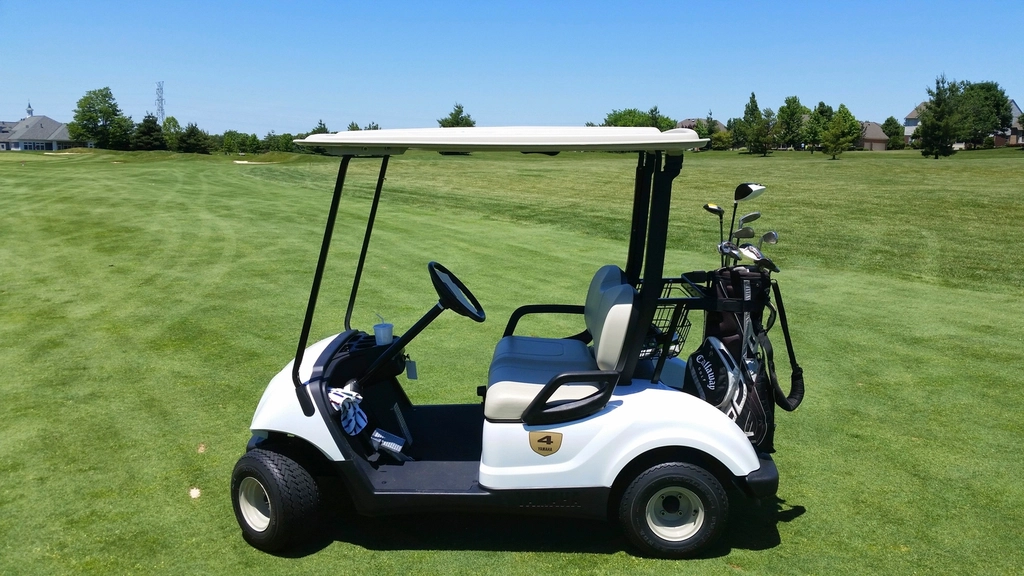
Short answer: Whether a golf cart may use a public road is set by your state and often by your town, so no seller can answer it without knowing your address. Low-speed-vehicle rules usually call for lights, indicators, mirrors, seat belts, a windshield and a VIN, and may add registration and insurance. Seven carts in our line carry a low-speed-vehicle rating from the maker: two are sold as LSVs and five reach that rating with the maker’s LSV package. A cart becomes street legal by being built or converted to the federal low-speed-vehicle standard and then titled, registered and insured as your state requires. Ask your local authority before you buy.
Why we never answer this directly
Whether a cart may be driven on a public road is set by state law and very often by your own
municipality on top of that. Two houses a few miles apart can have different answers. Anyone who
tells you a cart is “street legal” without knowing your address is guessing, and it is
your vehicle and your liability if the guess is wrong.
What the classifications generally involve
Rules commonly distinguish a golf cart from a low-speed vehicle, with the latter being a defined
classification carrying equipment requirements and a higher permitted speed. Requirements typically
touch on lighting, indicators, mirrors, seat belts, a windshield, a horn and a vehicle
identification number. Registration, insurance and a driving license may also apply. Which of those
apply to you is exactly the part we cannot answer.
What makes a golf cart street legal?
Two things, in the places that allow it at all: the cart has to be built as a low-speed vehicle, and it has to be titled, registered and insured as one under your state’s rules. The federal definition (49 CFR 571.3) covers a four-wheeled vehicle that reaches more than 20 mph but not more than 25 mph within a mile on a paved, level surface, with a gross vehicle weight rating under 3,000 lb. Federal Motor Vehicle Safety Standard No. 500 then requires headlamps, front and rear turn signals, taillamps, stop lamps, red reflex reflectors, a driver-side exterior mirror plus a passenger-side or interior mirror, a parking brake, a windshield of federal safety glazing, a VIN, a seat belt at every seating position, the rear-visibility requirement of FMVSS 111 and an alert sound. Our low-speed vehicle guide quotes the standard in full. A plain golf cart, which Florida defines as a vehicle not capable of exceeding 20 mph, is not an LSV and in Florida may only use roads a city or county has opened to carts; the Florida golf cart laws guide covers those rules.
How do you make a golf cart street legal?
Either buy a cart built and sold as a low-speed vehicle, or convert one and have it inspected. A conversion means fitting the FMVSS 500 equipment, bringing the top speed into the 20 to 25 mph band, and then satisfying your state: in Florida a converted golf cart has to be inspected and assigned a VIN before it can be titled, and the registered LSV must carry personal injury protection and property damage liability insurance. The bought route is simpler. Two carts we list are sold as LSVs, the Kandi Kruiser 6Pro and the MadJax X Series, and five Evolution models reach 25 mph with the maker’s LSV package; all seven are on our street-legal golf carts page. Whichever route you take, keep the paperwork that came with the cart and the title paperwork, because that is what the registration office asks for, and check the road rules where you live before you spend anything, since a legal LSV is still limited to the roads your state allows.
What we do tell you
Precisely what is fitted to the cart. Lighting, signals, mirrors, belts and glass all appear in
the specification where the manufacturer has supplied them. That is the factual part, and it is the
information your local authority will ask you about.
What the record does let us say: seven carts in our line carry a low-speed-vehicle rating from the manufacturer, two sold at 25 mph and five that reach it with the maker’s LSV package. They are grouped on the street-legal golf carts page, with the package caveat spelled out. If the cart will live in Florida, our Jacksonville and Ponte Vedra Beach page summarises the state rule for low-speed vehicles, and our Florida golf cart laws guide covers driver age, titles and road access; your county tax collector handles the registration.
How to get a real answer
Ask the body that would enforce it: your municipal clerk, city or county office, or state motor
vehicle department. Ask specifically about the class of vehicle and the roads you intend to use,
including whether crossing a higher-speed road is treated differently. Get it before you buy, not
after.
Be careful what you read
Forum answers and manufacturer marketing are the two least reliable sources on this topic.
Rules change, they vary locally, and a confident answer from someone in another state is worth
nothing where you live.
A cart can be excellent and not road-legal
Plenty of carts are bought for private property, a course, a campground or a gated community,
where none of this applies. If that is your use, the question simply does not arise. It only
matters when the cart has to use a public road, and then it matters a great deal.